Product Design / UX Strategy
Guided
Investment
Learning Path
Product Design / UX Strategy
Guided
Investment
Learning Path
Role
Head of Design
Year
H2 2022
Sector
Oct – Dec 2024
Team
Growth, Advisors, Asset Mgmt, Tech, Data, Legal
Overview
80% of AUM concentrated in one fund, not by choice, but by default
80% of AUM concentrated in one fund, not by choice, but by default
Users weren't distributing their investments. They were picking one option and staying there. Not because they were risk-averse — because the app gave them no frame to do anything else.
I ran the workshop where this problem surfaced, then led the team to design the flows, worked through compliance constraints, and tested everything with real users before development.
Problem
The product was asking complex decisions without any tools to interpret them
The product was asking complex decisions without any tools to interpret them
Users confused investment timeframes with mandatory lock-in periods. When they saw short-term losses in their intermediate strategies, they reverted to the conservative option.
A mandatory risk tolerance questionnaire required by law couldn't be removed — but its placement felt like a random legal detour, completely disconnected from the experience.
External research confirmed: users had mentally categorized DINN as "inversión para lo diario / chiquita" — a small, everyday tool — regardless of their financial sophistication. And the Actinver brand was the main reason new users decided to try the product at all. Trust came from the parent institution, not from the product experience.
The hypothesis: Users default in the conservative option because the product gives them no other frame to work with.
Core Design Decisions
Start with the person. Guide their autonomy
Start with the person. Guide their autonomy
1. Start with the person, not the product
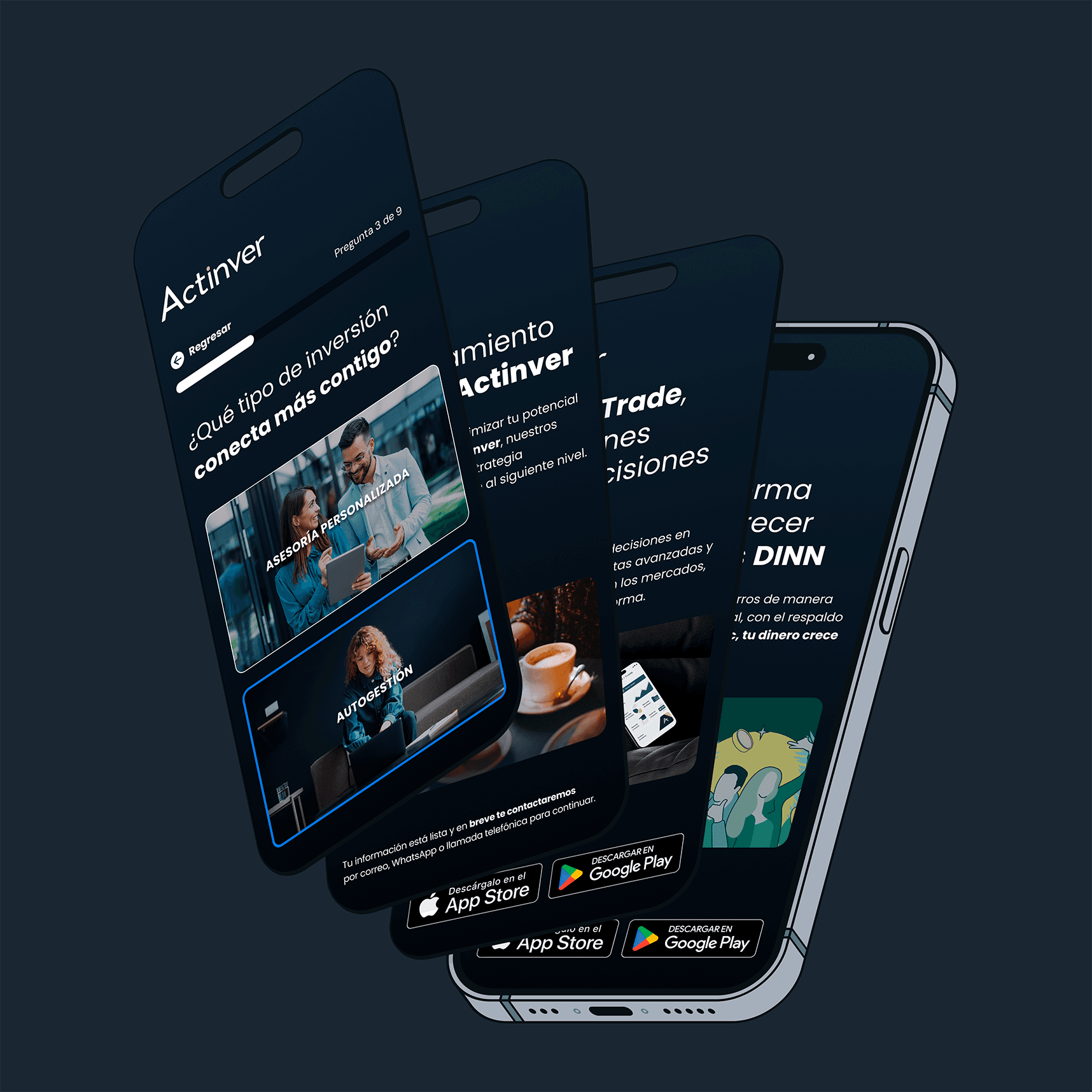
What are you saving for? What's your timeframe? How much can you set aside consistently? How do you feel about risk? Here's what we suggest — not a generic default.
2. Guided autonomy instead of forced restriction
Two distinct paths: Guided (Asesorada) — initial access to AhorraDINN, intermediate strategies unlock at $25,000 MXN (~3 months minimum salary), advanced strategies unlock after ≥80% emergency fund consistency for 3 consecutive months.
Non-Guided (No Asesorada) — complete the regulatory questionnaire and get immediate access to all strategies, with nudges encouraging good behavior without blocking anything.
3. Regulatory compliance as a trust signal
The questionnaire couldn't change — fixed by law. But where it lived in the flow could. We moved it from a random legal interruption to a necessary step toward getting a personalized recommendation. The unlock logic is tied to real financial readiness.
Process
Workshops, expert validation, recorded user sessions
Workshops, expert validation, recorded user sessions
Ran cross-functional workshops across Growth, Patrimonial Advisors, Asset Management, Tech, Data, and internal financial experts. Worked with financial advisors to make sure language was accurate. Translated design logic into actual technical rules with Product, Legal, and Engineering.
Every key trust metric moved in the right direction. The changes weren't subtle — users felt the difference immediately and consistently across both groups.
Outcome
The product shipped aligned with how users actually think
The product shipped aligned with how users actually think
Dual-path architecture, full regulatory compliance, behavioral framework validated with real users before any development started. The biggest change wasn't in the UI — it was in how the whole experience was structured.
Next project
Rebrand Into a Product System
Overview
80% of AUM concentrated in one fund, not by choice, but by default
Users weren't distributing their investments. They were picking one option and staying there. Not because they were risk-averse — because the app gave them no frame to do anything else.
I ran the workshop where this problem surfaced, then led the team to design the flows, worked through compliance constraints, and tested everything with real users before development.
Problem
The product was asking complex decisions without any tools to interpret them
Users confused investment timeframes with mandatory lock-in periods. When they saw short-term losses in their intermediate strategies, they reverted to the conservative option.
A mandatory risk tolerance questionnaire required by law couldn't be removed — but its placement felt like a random legal detour, completely disconnected from the experience.
External research confirmed: users had mentally categorized DINN as "inversión para lo diario / chiquita" — a small, everyday tool — regardless of their financial sophistication. And the Actinver brand was the main reason new users decided to try the product at all. Trust came from the parent institution, not from the product experience.
The hypothesis: Users default in the conservative option because the product gives them no other frame to work with.
Core Design Decisions
Start with the person. Guide their autonomy
1. Start with the person, not the product
What are you saving for? What's your timeframe? How much can you set aside consistently? How do you feel about risk? Here's what we suggest — not a generic default.
2. Guided autonomy instead of forced restriction
Two distinct paths: Guided (Asesorada) — initial access to AhorraDINN, intermediate strategies unlock at $25,000 MXN (~3 months minimum salary), advanced strategies unlock after ≥80% emergency fund consistency for 3 consecutive months.
Non-Guided (No Asesorada) — complete the regulatory questionnaire and get immediate access to all strategies, with nudges encouraging good behavior without blocking anything.
3. Regulatory compliance as a trust signal
The questionnaire couldn't change — fixed by law. But where it lived in the flow could. We moved it from a random legal interruption to a necessary step toward getting a personalized recommendation. The unlock logic is tied to real financial readiness.
Process
Workshops, expert validation, recorded user sessions
Ran cross-functional workshops across Growth, Patrimonial Advisors, Asset Management, Tech, Data, and internal financial experts. Worked with financial advisors to make sure language was accurate. Translated design logic into actual technical rules with Product, Legal, and Engineering.
Every key trust metric moved in the right direction. The changes weren't subtle — users felt the difference immediately and consistently across both groups.
Outcome
The product shipped aligned with how users actually think
Dual-path architecture, full regulatory compliance, behavioral framework validated with real users before any development started. The biggest change wasn't in the UI — it was in how the whole experience was structured.
Next project
Rebrand Into a Product System
Impact
80%
AUM in one strategy at baseline — the data point that defined the problem
5+
Prototypes tested with DINN clients — unlock logic and onboarding validated pre-dev
✓
Regulatory questionnaire repositioned as a trust-building UX step, not a detour
✓
Improved perceived clarity & confidence confirmed across all sessions